Media
Unreliable Grid, Rising Power Bills: How a Swan Marsh Dairy Farm Found a Better Way
A fourth-generation dairy farmer in Swan Marsh, Victoria shares how switching to a solar microgrid solved his power reliability problems and protected his farm from rising electricity costs.
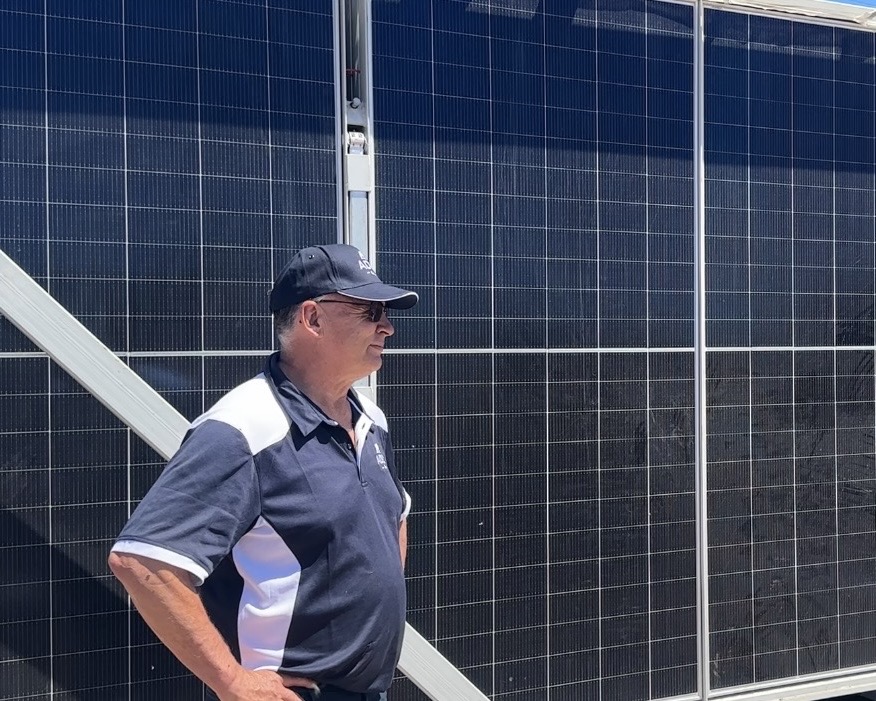
Dairy farmers across Victoria are dealing with the same two problems: a grid that isn't reliable enough for the demands of a working farm, and power bills that keep climbing with no sign of stopping.
For Peter Mulheron, a fourth-generation dairy farmer in Swan Marsh, Southwest Victoria, those problems came to a head. His family has worked the same land since 1906. Today he runs the farm with his wife Trish and son James, milking around 240 cows twice a day. He's also the Chairman of the Australian Dairy Farmer Corporation (ADFC).
Why power reliability matters on a dairy farm
On a dairy farm, power isn't optional. Cows need to be milked on a strict twice-daily schedule, and the equipment that makes that happen runs on electricity.
"It's very important that we have reliable power," Peter says. "The cows have got to be milked twice a day and we rely on power to do that."
In Swan Marsh, the grid doesn't always hold up. Bushfires in summer, storms in winter. Outages in the area can last anywhere from six to eight hours, sometimes longer.
"When we lose power out here, we usually lose it for an extended time."
The problem with relying on a generator
Peter's backup was a tractor-driven generator. It kept the farm running during outages, but it came with its own problems.
"The power is unstable because as the load goes up and down, the generator doesn't react quick enough to keep stable power."
Unstable power is hard on equipment and unreliable under pressure. It wasn't a solution, it was a workaround.
Why a Victorian dairy farmer chose a solar microgrid
Peter first came across PHNXX through an initial meeting with the team. The concept made sense: a modular solar-battery microgrid built for remote and off-grid operations. From there, he was fortunate enough to get onto a pilot program.
PHNXX brought a pilot module to the farm for three to four months of real-world testing.
"We were able to do some thorough testing on what the conditions were like here," Peter says. "As far as our power requirements were, they were able to design a system that was suitable for our farm."
"When we met the boys and discussed what our needs were, they seemed to understand what we were trying to achieve."
Reliable power and protection from rising electricity costs
The system is now installed and running. For Peter, the immediate difference is certainty.
"It gives us security of power supply. We know that when we need to milk the cows, the power's going to be there for us to do that."
Beyond reliability, the bigger picture is financial. Grid electricity prices have risen steadily, and for farms running high power loads, that exposure adds up.
"We're not exposed to the rising costs of power now. We'll be generating our own power. The fluctuation in power prices hopefully won't affect the profitability of the farm."
PHNXX's finance option also made the decision easier. Rather than a large upfront capital cost, monthly repayments are structured to match what the farm was already spending on power, making the switch cost-neutral from day one.
"It gives us some security to control the expenses on our farm."
What Peter would say to other dairy farmers
For any farmer weighing up their power setup, Peter's experience is straightforward.
"PHNXX have been great to deal with. They listen to what you need and they've been really good in constructing something that they think is going to be suitable for what you need."
We recently held a Demo Day at Swan Marsh, giving local farmers and industry guests a live look at the system in operation.
If you're interested in learning more about what a solar microgrid could mean for your farm, read full case study or talk to our team.


